Biomechanics – Sawbones® Biomechanical Testing Materials
Share to
Sawbones® is a global leader in biomechanical testing materials and orthopedic models, part of Pacific Research Laboratories, Inc., headquartered in Vashon, WA. Since its founding in the 20180 decade, the company has specialized in developing and manufacturing synthetic bone substitutes for orthopedic research, medical device testing, and surgical education and training.
After more than 40 years of development, Sawbones has become the global standard supplier of bone substitute materials for the orthopedic industry. Its products are widely used in bench testing of new devices, regulatory submissions, academic research, and preclinical validation. The company's product line ranges from simple polyurethane foam blocks to complex fourth-generation composite bone models, providing a standardized and reproducible testing platform for medical device development. This effectively addresses limitations associated with traditional cadaveric specimens, including restricted supply, high inter-individual variability, preservation challenges, and ethical concerns.
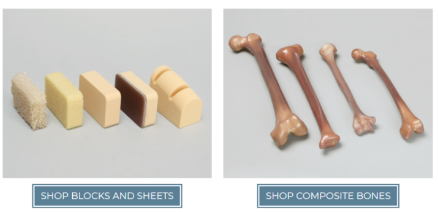
Sawbones Polyurethane Foam Test Blocks
Sawbones Polyurethane Foam Blocks (Solid Rigid) are closed-cell rigid polyurethane foam materials designed as substitutes for human cancellous bone in testing. Manufactured under controlled conditions, they feature uniform density distribution, precise dimensional tolerances, and repeatable mechanical properties.
Standard foam block dimensions are 130 mm × 180 mm × 40 mm; standard sheet dimensions are 130 mm × 180 mm × 3 mm. Material density ranges from 5 PCF to 50 PCF (0.08–0.80 g/cm³). Common grades include 10 PCF (low-density bone), 15 PCF (normal bone), 20 PCF (high-density trabecular bone), and 30 PCF and 40 PCF (cortical bone).
Physical and Mechanical Properties
Sawbones polyurethane foam features a closed-cell structure with a closed-cell content between 96.0% and 99.9%. Pore size varies with density; research indicates that as density ranges from 0.159 g/cm³ to 0.641 g/cm³, the average pore size spans 234 μm to 125 μm. This porous architecture mimics the trabecular network of human cancellous bone in morphology, although its microstructure is not an exact replica of real bone.
Typical mechanical properties of foams at different density levels, tested according to ASTM F1839 standard:
Density Rating (PCF) | Density (g/cm³) | Compressive Strength (MPa) | Elastic Modulus (MPa) | Typical Use Cases |
10 | 0.16 | 2.2–4.7 | 58–115 | Severe Osteoporosis |
15 | 0.24 | 4.2–5.4 | 104–154 | Osteoporosis/Normal Bone Transition |
20 | 0.32 | 5.4–8.4 | 154–265 | normal cancellous bone |
30 | 0.48 | 8.4–18.0 | 265–422 | high-density cancellous bone |
40 | 0.64 | 18.0–24.7 | 422–794 | Compact and cancellous bone |
Note: Specific values may vary slightly depending on test conditions and production batches, but all remain within the tolerance limits specified by ASTM F1839.
Absorption Rate: 0.0–0.301 kg/m². Low water absorption ensures stable performance in saline environments.
Hardness: Shore D hardness correlates well with elastic modulus and compressive strength, making it a reliable rapid quality control indicator.
Thermal stability: Maintains performance in a 37°C physiological saline bath, suitable for simulating the in vivo environment.
Anisotropy: Mechanical properties are optimal in the foam rise direction; ensure orientation is noted during testing.
Application Areas
1 Medical Device Biomechanical Testing
This is the primary application area for polyurethane foam test blocks, including:
Bone Screw Performance Testing: Evaluating pull-out force, anti-rotation capability, and more.
Orthopedic Implant Stability Testing: Assessing the long-term stability of prostheses, plates, and other implants.
Spine Surgery Research: Simulating Vertebral Structures to Test Pedicle Screw Fixation Systems
Fracture Fixation Device Validation: Evaluating the Effectiveness of Different Fixation Methods
2: Preclinical Research and Animal Testing Alternatives
Traditional animal bone experiments face significant limitations due to ethical constraints, high costs, and storage challenges. Polyurethane foam specimens serve as an effective alternative, substantially reducing research expenses and improving experimental reproducibility.
3 Medical Education and Training
This material is widely used in medical student bone skill training and surgical simulation for surgeons. By replicating real bone structures, it helps learners master surgical techniques and operational standards while reducing training costs and eliminating ethical concerns associated with using actual bone specimens.
4: Compute Model Validation
With the application of computer simulation technology in orthopedics, polyurethane foam test blocks are commonly used to validate the accuracy of computational models such as finite element analysis. Their uniform material properties and controllable mechanical parameters provide ideal conditions for model validation.
5: Osteoporosis Research
Sawbones' dedicated OLCB products simulate the mechanical properties of osteoporotic bone for studying implant performance and fracture risk in osteoporotic conditions.
Core Advantages
1: High Standardization and Repeatability
Compared to human cadaveric bone, Sawbones foam blocks exhibit minimal batch-to-batch variability, eliminating data scatter caused by individual differences. Studies show that the standard deviation of lateral bending stiffness for second-generation composite bone models is 15 times lower than that of cadaveric bone. This consistency ensures result comparability and statistical power, which are critical requirements for regulatory submissions and cross-laboratory studies.
2: Mechanical properties are controllable and adjustable
By selecting different density grades, researchers can precisely simulate various clinical scenarios ranging from osteoporosis to normal bone. For instance, 10 PCF foam simulates severe osteoporosis, 15 PCF represents normal bone, and 30–40 PCF corresponds to dense trabecular bone in young patients. This flexibility enables systematic parametric studies.
3: Cost-Effective and Easily Accessible
Polyurethane foam blocks cost significantly less than cadaveric specimens, require no special preservation facilities or ethical approvals, and can substantially shorten research timelines while reducing experimental costs. This advantage is particularly pronounced for mechanical testing requiring large sample sizes, such as pull-out strength and fatigue tests.
4: Convenience and Security of Operation
Foam blocks are easy to cut, drill, and machine using standard orthopedic instruments. The material is non-toxic and non-biohazardous, requiring no special biosafety precautions, making it suitable for use in standard laboratory environments.
5: Regulatory Recognition and Academic Authority
Sawbones foam blocks comply with ASTM F1839 international standards and are widely recognized by regulatory agencies such as the FDA and CE as standard test materials for orthopedic device submissions. Hundreds of published studies globally have utilized Sawbones products, creating a robust validation database that provides reliable literature support for new research.